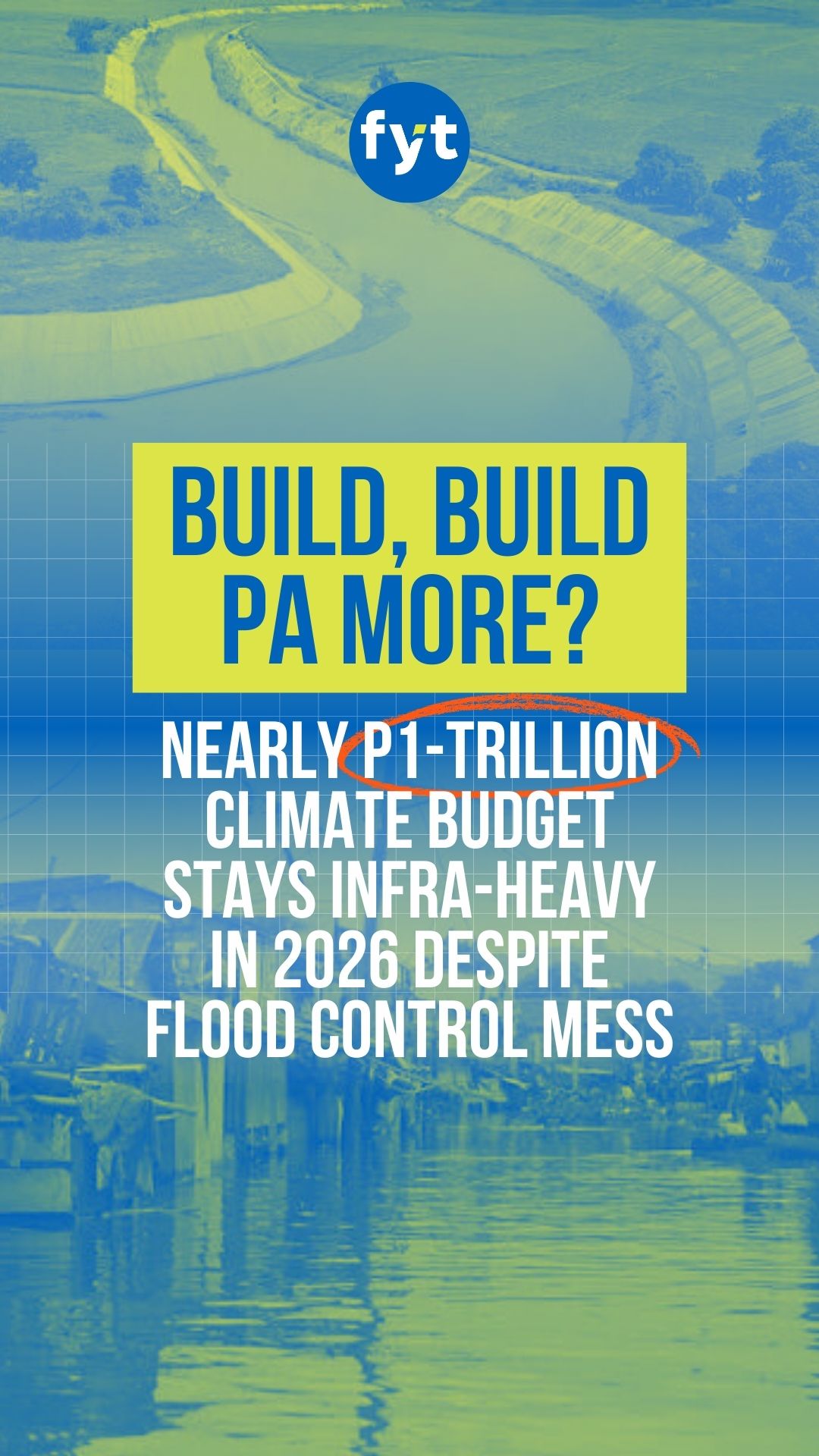
As floods worsen, the Philippine government is still betting the country’s climate mitigation and adaptation on concrete.
Despite public outrage over failed and allegedly corrupt flood control projects, the Marcos administration’s 2026 climate budget remains overwhelmingly infrastructure-driven.
CCET data from 2022–2026 shows most climate funds flow to flood control, roads, and transport, while climate science, ecosystems, and renewable energy receive only marginal support.
Even after the flood control backlash, climate-tagged spending continues to reflect business-as-usual construction, despite audit warnings that many projects lack evidence of actual risk reduction.
(This story uses AI to extract granular insights from thousands of climate-tagged budget line items. All findings were reviewed and verified by journalists.)
MANILA, Philippines - The Philippines is currently the most disaster-prone country in the world, but our climate budget is still obsessed with one thing: more concrete.
Even after all the public outcry over “ghost” flood control projects and the massive corruption scandal behind it, President Ferdinand Marcos Jr’s administration is still pouring ₱983.8 billion into concrete and steel as its primary way to save the country from drowning.
The narrative shift began after Marcos brandished the “completion” of 5,500 flood control projects during his July 2024 State of the Nation Address. That quickly backfired when Typhoon Carina submerged Metro Manila a few days later, exposing the reality that all those dikes and walls didn't actually keep the water out.
Since then, the government has tried to slowly rebrand its climate agenda, suddenly hyping up what it describes as "sustainable energy" in its public-facing documents.
But even with this green rebranding, the multi-billion peso backbone of the climate agenda is still made of reinforced concrete and steel, while other scientific interventions are left snubbed at the periphery.
To understand why, we take a look at the National Climate Change Expenditure Tagging (CCET). It essentially serves as the government’s green highlighter.
Every year, agencies take their massive budget requests and tag specific projects as “climate-related” under the National Climate Change Action Plan (NCCAP).
It identifies seven strategic priorities to address climate impacts:
This tagging system is supposed to help us track climate action. But our analysis of the CCET data from 2022 to 2026 shows that funds are funneled through big-ticket infrastructure projects.
RELATED: ₱1.1-T Climate Budget, But PH Still Drowning: Where Is The Money Going?
To track the flow of these funds, we retrieved the available CCET data spanning five years:
The data was cleaned and visualized manually to maintain accuracy. We also deployed artificial intelligence to extract granular insights from thousands of line items, specifically to compare the NCCAP strategic priorities against actual appropriations.
The historical trend shows a persistent reliance on “hard” solutions. Despite the ongoing flood control mess, the 2026 proposed climate budget this year continues the same trajectory.
If you look at the top three priorities where the most money is being earmarked, the numbers show that the climate agenda is less about the environment and more about the cement mixer.
Under the NCCAP’s Water Sufficiency priority, you might expect the budget to focus on clean drinking water or restoring our dying watersheds. Instead, the data shows this category is a vault for the Department of Public Works and Highways (DPWH).
In the 2026 proposed budget, ₱280 billion is earmarked for projects “incorporating climate change in design standards for flood control and drainage systems.”
The Department of Environment and Natural Resources (DENR), the agency actually in charge of our natural water resources, is only allocated ₱1.24 billion for sanitation and wastewater design. In short, for every ₱1 we spend on protecting the environment, we spend over ₱200 on plopping up concrete flood walls.
The disparity is even wilder in hindsight. In 2024, the DPWH was allocated ₱411.5 billion worth of projects under the same priority. That is nearly 40 times the combined climate budgets of the Department of Science and Technology, the DENR, and the Climate Change Commission for the same year. Those three agencies responsible for climate science and monitoring only got about ₱10.48 billion in funds together.
DPWH also has the largest share (₱169.1 billion) under the Climate Smart Industries and Services priority for retrofitting projects.
Despite attempts to distance itself from the flood control fiasco, the government shows no signs of moving away from the concrete. While the government is hyping up a shift to sustainable energy, CCET data shows that money supposedly earmarked for this priority is actually being allotted to pave the way — literally.
Of the proposed ₱411.3 billion for this year, the DPWH gets the lion’s share at ₱254.6 billion (61.9%), followed by the Department of Transportation (DOTr) at ₱131.7 billion (32%).
While you’d expect this money to go to solar or wind farms, the largest chunk goes straight to the DPWH for “constructing new roads, ports, and airports to climate resilient design standards.” The DOTr also gets a massive ₱125.9 billion slice for urban traffic management and railway construction to “reduce greenhouse gas emissions.”
Actual renewable energy projects, meanwhile, are left with crumbs. State corporations and universities are only allocated around ₱680 million combined for “constructing or rehabilitating energy generation from renewable sources.”
The funding for soft infrastructure – such as mangrove restoration, watershed protection, and reforestation – remains meager. Last year, the DENR was allocated only ₱5.6 billion for ecosystem and environmental stability, a tiny fraction of the budget for cemented structures.
The 2024 Performance Audit Report on the NCCAP confirms that this is not just a massive budgetary imbalance, but also a failure in oversight.
State auditors found three red flags in how climate money is handled:
By funneling the majority of climate funds into big-ticket infrastructure while neglecting the environment, the budget moves in the opposite direction of the country's official climate promises.
The Philippines has committed to a 75% emissions reduction target by 2030. But as the Nationally Determined Contribution (NDC) Implementation Plan warns, only a fraction of our climate spending is actually linked to those goals. In 2023, for instance, only 9.25% of tagged climate funds were directly tied to these international commitments.
As the floodwaters continue to rise in our streets, the data suggests that more bags of cement won’t fix a policy that refuses to invest in nature. Until the budget shifts its focus from infrastructure to the environment, the promise of a climate-resilient Philippines will remain as hollow as a ghost project. - fyt.ph
Seen a climate, flood control, or other infrastructure project that worked — or failed?
Help document what’s really happening on the ground. Upload photos or share details at app.lyfsaver.ph.
Your proof can hold public officials accountable and safeguard taxpayers’ money. Fyt!