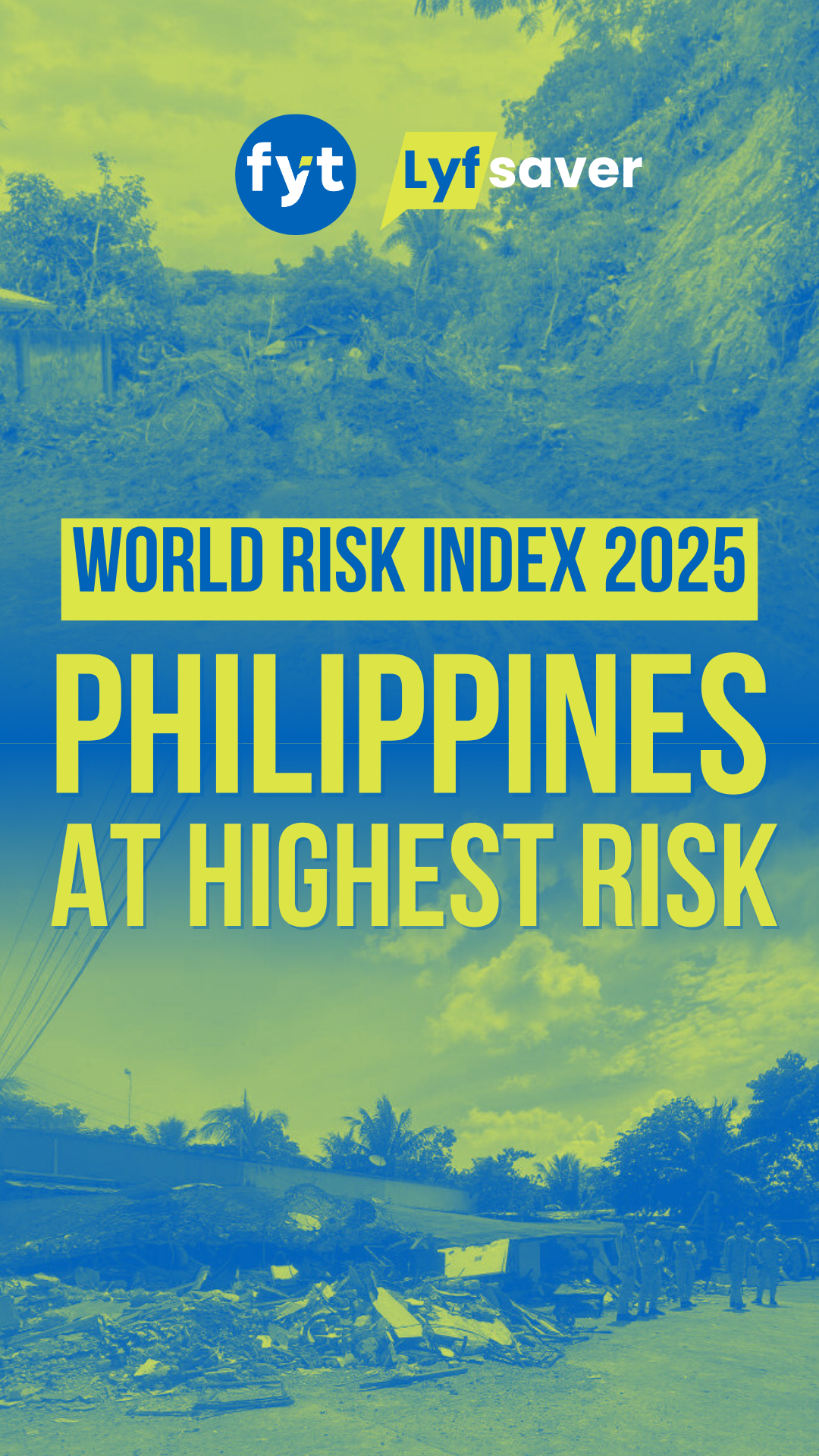
MANILA, Philippines – The Philippines is once again the most disaster-prone country in the world.
The Philippines topped the WorldRiskIndex 2025 with an overall score of 46.56, according to the WorldRiskReport 2025 released by Bündnis Entwicklung Hilft (BEH) and the Institute for International Law of Peace and Armed Conflict (IFHV) at Ruhr University Bochum.
The index placed the country fourth in exposure (39.99) and recorded a vulnerability score of 54.20, underscoring how geographic fragmentation, tectonic instability, and extreme weather events continue to drive disaster risks nationwide.
The Philippines has consistently led the global ranking in recent years, with scores of 46.82 in 2022 (theme: Digitalization), 46.86 in 2023 (Diversity), and 46.91 in 2024 (Multiple Crises).
This year’s focus on floods once again highlighted the country’s heightened risk profile, coinciding with Filipinos’ scrutiny of alleged corruption in flood control projects.
While the 2025 report centers on floods, the WorldRiskIndex also integrates seismic hazards, including earthquakes and tsunamis, into its exposure model.
The Philippines’ exposure score of 39.99 reflects its multi-hazard vulnerability, encompassing risks from:
The report attributes the Philippines’ consistently high ranking to the intersection of tectonic and climatic threats, compounded by dense populations and uneven infrastructure resilience.
Situated along the Pacific Ring of Fire, where about 90% of the world’s earthquakes occur, the country faces chronic seismic exposure. Historical events such as the magnitude 7.8 earthquake in Luzon in 1990 as well as recent tremors in Mindanao and northern Luzon illustrate the persistent danger of destructive quakes.
In the WorldRiskIndex framework, exposure measures how frequently and severely a population or area is subjected to natural hazards.
It represents the likelihood that people, infrastructure, and ecosystems will be affected by damaging events, rather than how well they can recover afterward.
According to the report, exposure encompasses seven major hazards: Earthquakes, tsunamis, coastal flooding, riverine flooding, cyclones, droughts, and sea-level rise.
The Philippines’ high exposure score (39.99) means that a large portion of its population and territory lies in areas repeatedly threatened by multiple hazards, particularly earthquakes, typhoons, and floods.
The report’s localized exposure analysis identified Cagayan as the province with the highest flood risk, scoring 88.10, followed by Agusan del Norte (87.51), Pangasinan (85.19), Pampanga (83.49), Maguindanao (82.94), and Metro Manila (81.12).
These areas are characterized by flat terrain, wide river basins, and dense populations, making them especially prone to prolonged flooding when typhoons strike.
Major rivers such as the Cagayan, Agusan, Agno, Sinocalan, and Pampanga drain slowly, exacerbating inundation.
In contrast, Marinduque, Laguna, Batanes, and Sarangani registered the lowest exposure scores, benefiting from smaller catchment areas, natural drainage systems, and higher elevations that mitigate flood and seismic impacts.
Globally, floods remain the most frequent and destructive natural disasters, affecting 1.6 billion people and causing over US$650 billion in losses between 2000 and 2019.
The Philippines, situated in the typhoon belt and composed of over 7,600 islands, continues to experience the compounded impact of both climatic and tectonic hazards.
The report warns that rapid urbanization, poor land use, environmental degradation, and social inequality further heighten vulnerability. Existing protection systems, it said, are increasingly overwhelmed by the intensifying effects of climate change.
Toward resilience and preparedness
To address these risks, the report calls for a shift from reactive disaster response to proactive risk reduction, in line with the Sendai Framework for Disaster Risk Reduction (SFDRR).
The report urges the following:
As the Philippines once again emerges as the world’s most at-risk nation, the report stresss the urgent need to translate scientific foresight into transparent governance and resilient infrastructure.
The challenge, it concludes, lies in transforming vulnerability into preparedness, before the next disaster strikes.
📘 Read the full report: https://www.ifhv.de/publications/world-risk-report
– fyt.ph