

As the United Nations (UN) declares the planet’s climate in a “state of emergency,” the Philippines – consistently ranked among the most disaster-prone countries in the world – faces intensifying risks, even as it contributes only a small share of global emissions.
For Filipinos, this is a lived reality: stronger typhoons, rising seas, and communities forced to rebuild again and again. As global temperatures climb, the risks facing climate-vulnerable nations like the Philippines are compounding faster than systems can adapt.
The Earth’s climate is now more out of balance than at any point in recorded history.
The amount of heat trapped within the Earth system reached an unprecedented high in 2025, capping the hottest 11-year streak since modern record-keeping began, the World Meteorological Organization (WMO) said in its report released March 23.
“Our global climate is in a state of emergency,” UN Secretary-General Antonio Guterres wrote on X.
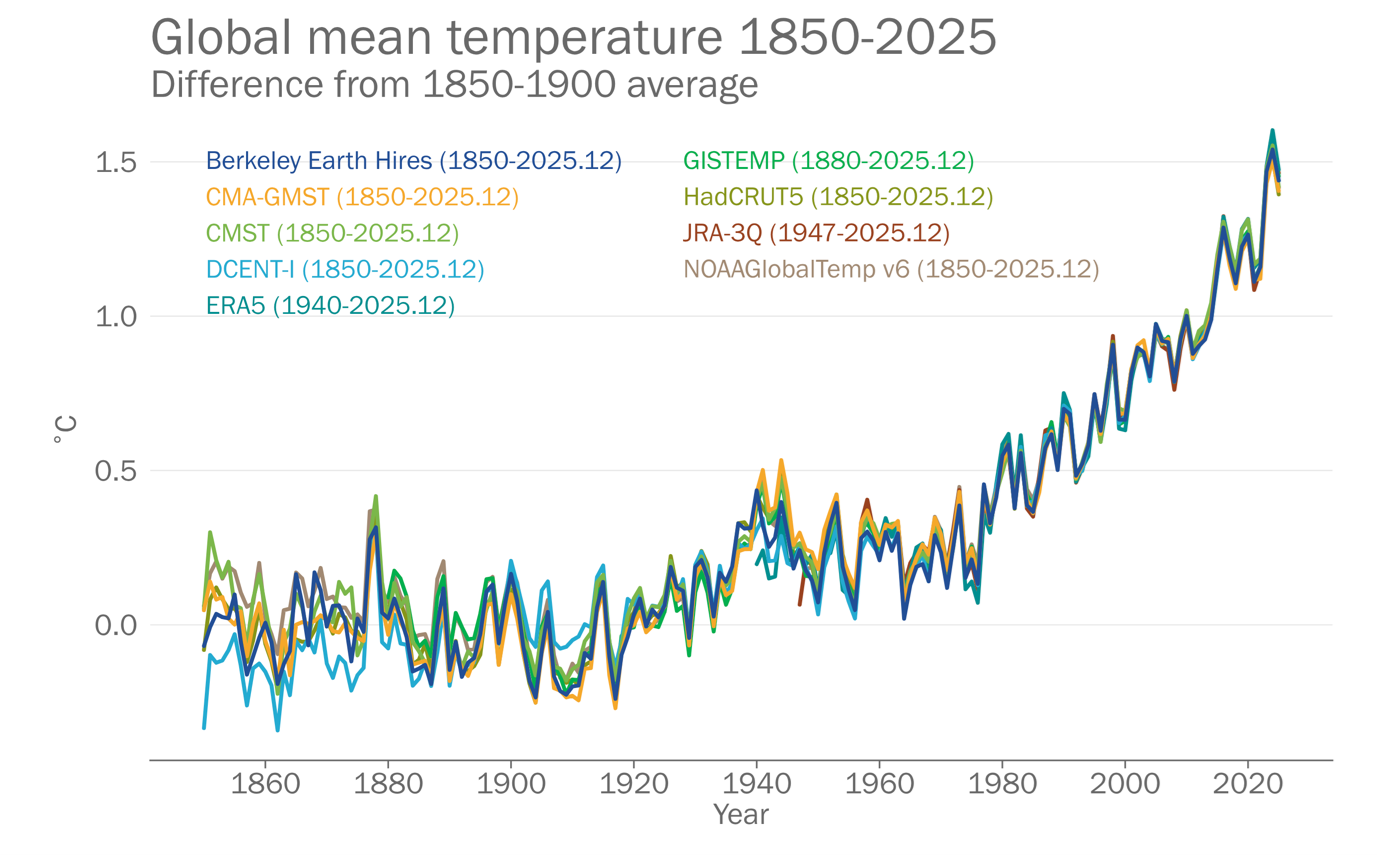
The latest State of the Global Climate report found that 2025 was either the second or third warmest year on record, with global temperatures reaching about 1.43 degrees Celsius above the pre-industrial average.
But 2024 – which started with a strong El Niño – remains the hottest year, with global near-surface temperatures at about 1.55 °C above the preindustrial average.
Behind these rising temperatures lies a deeper problem. The WMO introduced a new metric to track the crisis: the Earth's energy imbalance.
Under a stable climate, the energy coming from the sun is balanced by heat radiating back into space. But skyrocketing concentrations of greenhouse gases have trapped a massive surplus of energy.
This throws the budget into a severe deficit. This energy imbalance is the highest in a 65-year observational record, the WMO said.
“Planet Earth is being pushed beyond its limits. Every key climate indicator is flashing red,” Guterres said.
WMO Secretary-General Celeste Saulo noted that human activities are increasingly disrupting the planet's natural equilibrium.
"We will live with these consequences for hundreds and thousands of years," Saulo said.
The excess energy trapped by greenhouse gases does not just warm the air. The warming people feel near the Earth's surface only accounts for about 1% of this trapped heat. Another 5% is absorbed by continental land masses.
Around 3% goes into warming and melting polar ice. But over 91% plunges directly into the ocean.
RELATED: Our world is burning up. How do we beat the heat in the long run?
Nowhere is this imbalance more visible than in the oceans.
Ocean heat content reached another record high in 2025. The rate of ocean warming over the last two decades is more than double the rate observed between 1960 and 2005, the report said. The ocean absorbed heat equivalent to about 18 times the annual human energy use every year for the past 20 years.
This deep-water warming fuels tropical storms and wipes out marine biodiversity.
As oceans absorb both heat and carbon dioxide, they also become more acidic, threatening marine life and global food systems.
Despite the temporary cooling effects of the La Niña weather pattern in 2025, around 90% of the global ocean surface still experienced at least one marine heatwave.
These physical changes to the Earth's thermal budget translate to tangible disasters on the ground.
Extreme weather events in 2025 killed thousands, displaced millions, and caused billions of dollars in economic losses.
Glaciers melted at exceptional rates in Iceland along the Pacific coast of North America, while Antarctic sea ice fell to its third lowest level on record.
These rapid shifts also trigger public health crises.
The report noted how rising temperatures and shifting rainfall patterns are expanding the reach of vector-borne diseases, with dengue now the world’s fastest-growing mosquito-borne disease. It places roughly half of the global population at risk, the UN agency said.
Workplace heat stress is also endangering over a third of the global workforce. This primarily affects those in agriculture and construction.
Yet only half of the world's countries have early warning systems tailored to health sector needs, the WMO stated.
The planet continues to absorb more heat than it releases. Guterres noted that the world's reliance on fossil fuels is destabilizing global security.
“When history repeats itself 11 times, it is no longer a coincidence,” Guterres said. - fyt.ph


.jpg)