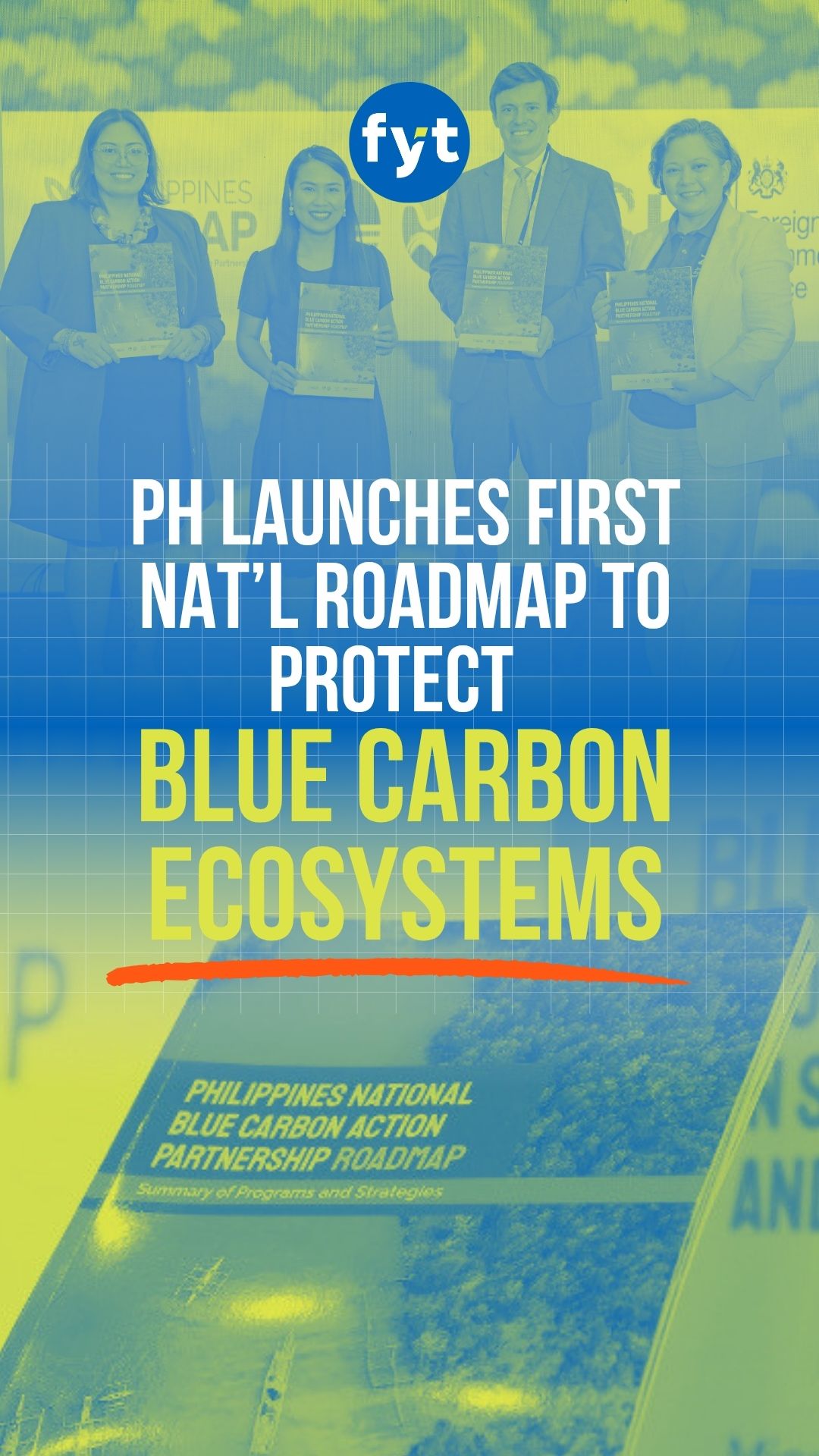
The Department of Environment and Natural Resources (DENR), in partnership with the Zoological Society of London, and the World Economic Forum, launched the National Blue Carbon Action Partnership Roadmap during a three-day conference held in Manila on March 24 to 26.

The initiative aims to protect the country’s 327,000 hectares of mangrove forests and 27,282 square kilometers of seagrass ecosystems.
As super typhoons grow more destructive and sea levels continue to rise, the roadmap provides a comprehensive strategy to conserve these ecosystems, which are among the most powerful yet overlooked defenses against climate change.
"Blue carbon ecosystems are not just environmental assets, they are strategic natural infrastructure for the Philippines' coastal communities and its economy,” said Dr. Alfredo Giron of the World Economic Forum during the turnover ceremony.
The Philippines is among the first countries globally to establish a coherent national framework for blue carbon.
Blue carbon refers to the carbon captured and stored by marine and coastal ecosystems, particularly mangroves and seagrasses.
These ecosystems absorb carbon dioxide at rates up to four times higher than terrestrial forests, while simultaneously protecting coastal communities against storm surges and providing habitat for fish.
For a nation of more than 7,000 islands with one of the longest coastlines in the world, the stakes are high. But these natural defenses are rapidly disappearing.
“Over just a few decades, three decades, I have seen myself how much human activity can damage the natural environment,” said Mariglo Laririt of the DENR’s Biodiversity Management Bureau during the conference.
She also noted that despite the urgency, government agencies remain understaffed and stretched thin.
The roadmap is structured around four pillars: policy and governance, science and innovation, community engagement, and sustainable funding.
Under the policy pillar, the DENR is working on a National Ocean Environment Policy expected to be finalized before the end of 2026.
On the financing front, diverse funding mechanisms beyond traditional grants are being explored.
Dr. Jerome Dimayor, Executive Director of the ASEAN Center for Biodiversity, pointed to innovative models from neighboring countries.
These include Malaysia’s ecological fiscal transfer, which is a system where local governments receive cash incentives for prioritizing conversion, and Thailand’s passport system that encourages visits to national parks.
For coastal communities, conservation cannot come at the expense of livelihoods. During the panel discussion, speakers raised concerns about the displacement of informal settlers due to coastal development projects.
"The emphasis is on engagement and capacity," Laririt said during the panel discussion. "When we go to the communities, we have to be ready to lose ourselves in them and to invest ourselves in them."
The roadmap also includes provisions for community-led enterprises, from ecotourism to sustainable aquaculture, designed to ensure that conservation delivers tangible economic benefits to the people who live alongside these ecosystems.

With the roadmap now officially adopted, the focus shifts to implementation. The DENR will convene a steering committee and technical working group, with x
"As we move forward under DENR leadership, the focus is to ensure that this system translates into measurable outcomes. Hold us to account. Hold government to account. Because all of these efforts have yet to translate to real benefits on the ground,” Laririt said in the conference.
British Ambassador to the Philippines Lloyd Cameron, whose government has supported the roadmap through the UK’s Food Planet Fund, emphasized the partnership’s importance.
"Blue carbon rarely makes the headlines, but it might be one of the most powerful tools that we have," Cameron said during the program. "The microbes and related ecosystems we protect today will shape the world." - fyt.ph