Trust in news in the Philippines plummeted by 10 points in 2026, the steepest decline among all 48 markets covered by this year’s Reuters Institute Digital News Report, amid deep political divisions, sustained attacks on the media and a continued shift toward social media, video platforms, creators and AI tools.
Only 28% of adult Filipino respondents said they trusted most news most of the time, down from 38% in 2025 – a sharper fall than in Ireland, Thailand, Peru and Poland, also among the markets with the sharpest declines this year.
The DNR, now in its 15th year, is based on an online YouGov survey of more than 97,000 adults across 48 markets, including 2,021 in the Philippines, for the Reuters Institute for the Study of Journalism at the University of Oxford.
The fall pulled the Philippines below the global average of 37%, itself the lowest level since the DNR began tracking trust in news in 2015. It erased recent gains: Trust stood at 27% in 2020, rose to 38% in 2025, then dropped back to 28% this year.
The global report cautions against reading the trust decline only as a verdict on newsrooms. In the hardest-hit countries, it pointed to “political instability, divisive elections,” “a noisier and more fragmented information environment” and direct attacks on news outlets and journalists.
The Philippines fits most of those conditions. From the Duterte years to the Marcos administration, its public sphere has been marked by political polarization, disinformation, especially during elections, alongside red-tagging, lawfare, online harassment, media criticism and killing of journalists. These pressures now collide with a platform-driven environment where professional reporting competes with partisan and influencer-driven content.
Low trust was more pronounced among lower-income and lower-education respondents. Only 23% of low-income respondents said they trusted most news most of the time, compared with 43% of high-income respondents. Trust was 21% among respondents with low education,compared with 32% among university graduates.
Trust in specific news brands in the Philippines tells a more nuanced story. Brand trust was broadly stable from 2025 to 2026, with most measured brands moving only within a narrow range of about three points up or down. Longer term, however, most tracked brands had lower trust ratings than their first available scores, with declines of about three to 10 points.
Even so, individual news brands remained more trusted than news overall, with trustworthy scores clustered in the high 50s to mid-60s, far above the 28% overall trust figure.
Even as overall trust in news fell, concern about false or misleading information remained near its peak. Two-thirds of Filipino respondents, or 66%, said they were concerned about what is real and fake online, essentially unchanged from the record 67% posted in 2025.
That mix of concern, distrust and changing habits reflects what the global report describes as a more volatile news environment. In the Philippines, that volatility manifests as declining interest, increased news avoidance, and shifting consumption habits.
One sign is declining interest in news. Filipinos who said they were extremely or very interested in news dropped from 49% in 2025 to 43% in 2026, a steep slide from 69% in 2020.
The audience is also becoming less intensely engaged. News lovers declined from 22% in 2025 to 19% in 2026, while casual or passive users climbed from 26% to 32%. The shift was sharper among younger Filipinos: 42% of 18- to 24-year-olds were casual or passive users, versus just 20% among those 55 and older.
News access also became less frequent. The share of Filipino respondents accessing news several times a day fell from 50% in 2025 to 45% in 2026, down from 63% in 2020. Daily or more frequent access dropped from 75% to 70% in the past year, and from 86% in 2020.
News avoidance added another layer to the disengagement. In 2026, 51% said they often or sometimes actively avoided news, up from 48% in 2025. Avoidance was higher among low-income respondents, at 55%, than among high-income respondents, at 42%.
The decline in trust and engagement is happening as news consumption becomes more platform-led. Across DNR markets, social media and video networks overtook both television and news websites and apps as sources of news for the first time. Across all markets, they are now used for news by 54% of respondents; adding AI chatbots brings the third-party total to 56%.
In the Philippines, this drift is already advanced. Social media and video networks were the only major weekly news source to grow, rising from 66% in 2025 to 70% in 2026. By contrast, TV fell from 46% to 42%, print from 13% to 10%, radio from 17% to 14%, and news websites and apps from 50% to 42%. Since 2020, TV has fallen from 66% to 42%, print from 22% to 10%, radio from 25% to 14%, and news websites and apps from 60% to 42%.
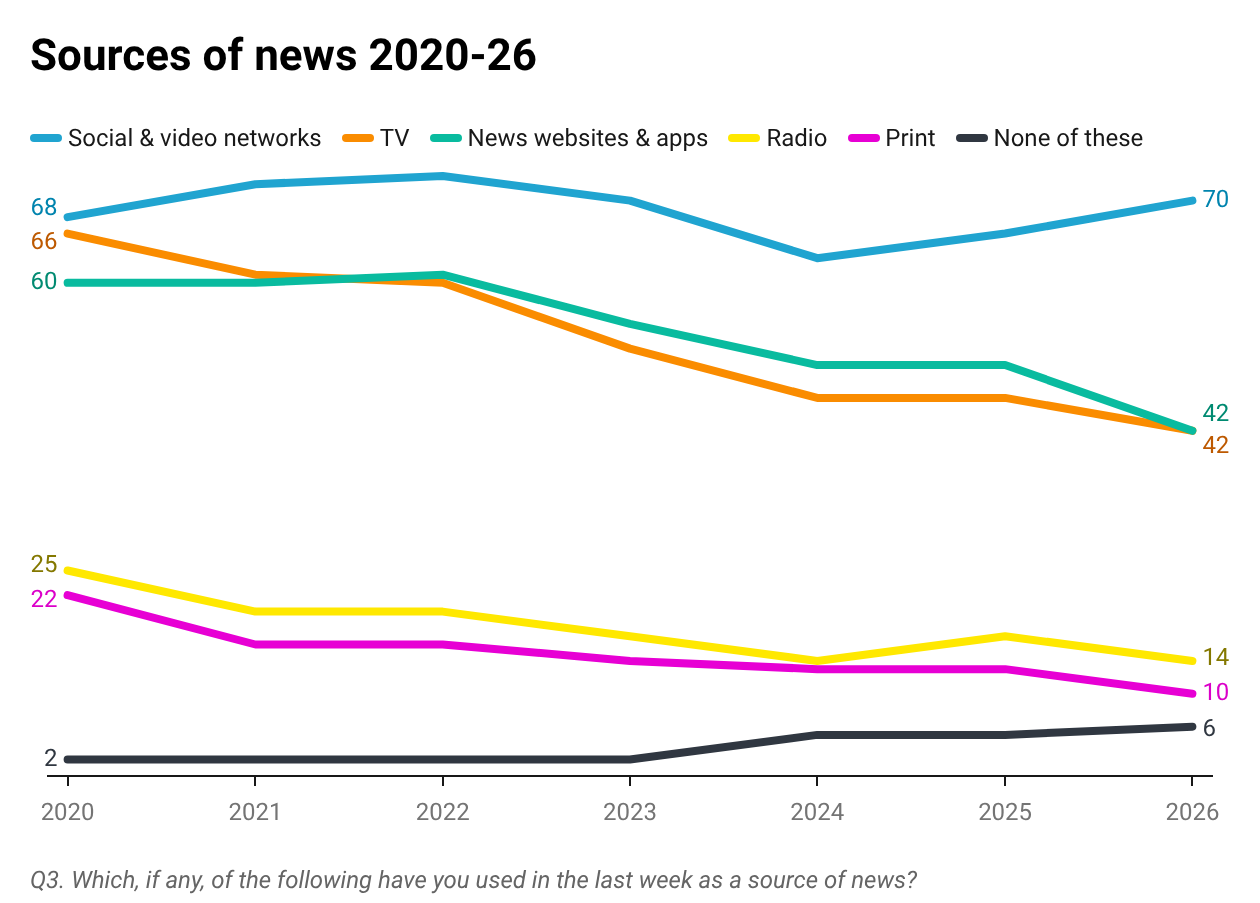
The pattern is not simply “digital replacing legacy.” Even online news outside social media and video networks has weakened, while more news is encountered in third-party environments and direct or branded routes lose ground.
Facebook dominated, with 79% of Filipinos using it for news, followed by YouTube at 45% and TikTok at 33%. Globally, the Philippines ranked among the higher-use markets for TikTok and YouTube news.
This matters because trust is lowest in the spaces where more people encounter news. Globally, 22% trusted news in social media and one in five trusted answers from AI chatbots, compared with 37% who trusted news overall. In the Philippines, trust in news in social media stood at 19%, while trust in answers from AI chatbots was lower still, at 15%.
The platform shift is also reshaping video. As the global report put it: “The first wave of social media growth hit newspapers hardest. Now the second wave is affecting news organizations’ TV and video interests.”
The Philippines is living that second wave in real-time, with news video moving further into platform spaces. Facebook news video use rose from 58% in 2025 to 66% in 2026, while TikTok rose from 30% to 36%. Since 2020, watching news video on Facebook has risen from 54% to 66%, while watching on a news website or app has almost halved, from 39% to 21%.
Shorter videos were the norm. About 83% of Filipinos used them on X, 81% on Instagram, 80% on TikTok, and 78% on Facebook. YouTube stood out: 58% watched shorter clips, but 52% also consumed longer videos, making it the strongest space for long-form news.
This year’s DNR shows that some audiences once had regular news habits but no longer do. Among Filipino respondents, 42% still used TV for news in the past week, while 32% had done so regularly before but no longer did. Radio and newspapers looked weaker: 14% still used radio for news, while 32% had stopped; for newspapers, only 8% were current users, 27% were lapsed users and half had never used them regularly.
Adoption measures the full scope of people who have used a medium (current plus lapsed users), while retention narrows that to those who remain weekly users. Among traditional media, TV had the widest past reach, with 75% adoption and 57% retention. Radio and newspapers had smaller adopted audiences and weaker retention: 46% and 29% for radio, 36% and 24% for newspapers.
News habits also appear looser. Half of Filipino respondents said they use the same devices to access news every day, but far fewer said the same about the brands or outlets they use, at 23%, the activities they do while accessing news, at 22%, and the topics they follow, at 17%. Audiences may be using the same screens, but not necessarily returning to the same sources, subjects or routines.
markets, 46% get news from creators of any type and 27% from news-focused creators. The Philippine figures are well above the global figures: Two-thirds of Filipinos used some type of creator in the past week, 36% turned to news-focused creators, while 46% followed non-news creators who occasionally discuss current events.
Survey responses reveal that Filipinos cast a wide net when defining "creators" and "influencers," often blurring the distinction between professional journalists and social-first personalities. Many respondents categorized established news figures as "news-focused creators." While some of these journalists maintain independent digital channels, others are encountered primarily through newsroom or program-branded accounts.
This blurring is even more apparent with creators who focus on non-news topics but occasionally touch on current events. Respondents cited a diverse mix of news personalities alongside figures from the entertainment, lifestyle, comedy and finance spheres. The overlap suggests that when consuming news online, audiences no longer draw a sharp line between traditional journalists, public affairs hosts and digital commentators.
Creator-driven news use was age-skewed: 71% of 18- to 24-year-olds consumed news from creators or influencers, compared with 56% of those 55 and older. Younger respondents were also more likely to follow non-news creators who sometimes touch on current events, 52% versus 37%.
Half of those who followed news-focused creators said they met most of their information needs, but only one in eight felt they met all their news needs. This suggests creators supplement rather than replace traditional outlets.
Their appeal lies less in trust than in being entertaining, relatable, easy to understand, and up-to-date compared with traditional news brands. Trust was split: 22% said creators were more trustworthy and 21% less. On impartiality, 19% said creators were less impartial, compared with 14% who said they were more impartial.
AI chatbots remain a smaller but notable part of the news ecosystem. Globally, chatbot news use rose from 7% to 10% over the past year, though growth lagged behind other AI uses. In the Philippines, weekly chatbot news use held steady at 9%, close to the global average. It was higher among 18- to 24-year-olds (11%) than among those 55 and older (3%).
The Philippine data do not show AI chatbots as a mass replacement for news brands but as a news-processing tool. Among weekly generative AI news users, 52% asked for summaries, 48% posed follow-up questions, 43% sought the latest news, 39% asked it to find or assess a source, and 36% used it to simplify stories.
Motivations were largely practical: Half valued AI’s ability to simplify complex stories, 49% said it could answer any question, and 48% appreciated the option for follow-ups. Others cited speed, translation, and the ability to compile reports from multiple outlets.
The Philippine data show a weaker attachment to impartial news than the global pattern. When asked about their personal preference, Filipinos were evenly split: 30% favored sources that share their views, and 30% favored those that challenge them. Just 23% preferred sources without a particular point of view.
Their view of what society should favor was similarly divided: 27% said others should get news from sources that share their perspective, 28% preferred sources without a particular point of view, and 29% favored those that challenge prevailing views. Globally, by contrast, the largest group preferred news without a particular point of view, both for themselves and for society.
Filipinos also gave news media tepid marks for coverage of major stories. For every issue tested, the largest share rated coverage as neither good nor bad. The media’s strongest net rating (good job minus bad job) was on migration and immigration, while ratings on inflation and the cost of living were evenly balanced. Coverage of the Middle East conflict drew slightly negative marks, and the weakest ratings were for reporting on the war in Ukraine.
Yvonne T. Chua is a professorial lecturer of journalism at the University of the Philippines. She has been writing the profile on the Philippines for the Digital News Report since 2020.