

Mount Pulag National Park in the Philippine Cordillera Mountain Range has become a famous spot for hikers for its sea of clouds and rich biodiversity, home to more than 500 plant species and several animal species.
But for Gelo Arboleda, a wildlife and landscape photographer, foot traffic in Mount Pulag National Park is now “incomparable” to his first hike almost 13 years ago.
Now capped at 600 people per day, the surge in visitors has raised concerns over environmental damage, including excessive garbage and biodiversity loss.
“Talagang grabe ‘yong foot traffic ng Mount Pulag. I cannot say if it's for the better,” said the former Science Research Technician III of the Department of Environment and Natural Resources (DENR) Ecosystems Research and Development Bureau. “Pero considering the fact that Mt. Pulag is a protected landscape, any human disturbance is always not good.”
(The foot traffic in Mount Pulag is much more intense now. I cannot say if it’s for the better. But considering the fact that Mount Pulag is a protected landscape, any human disturbance is always not good.)
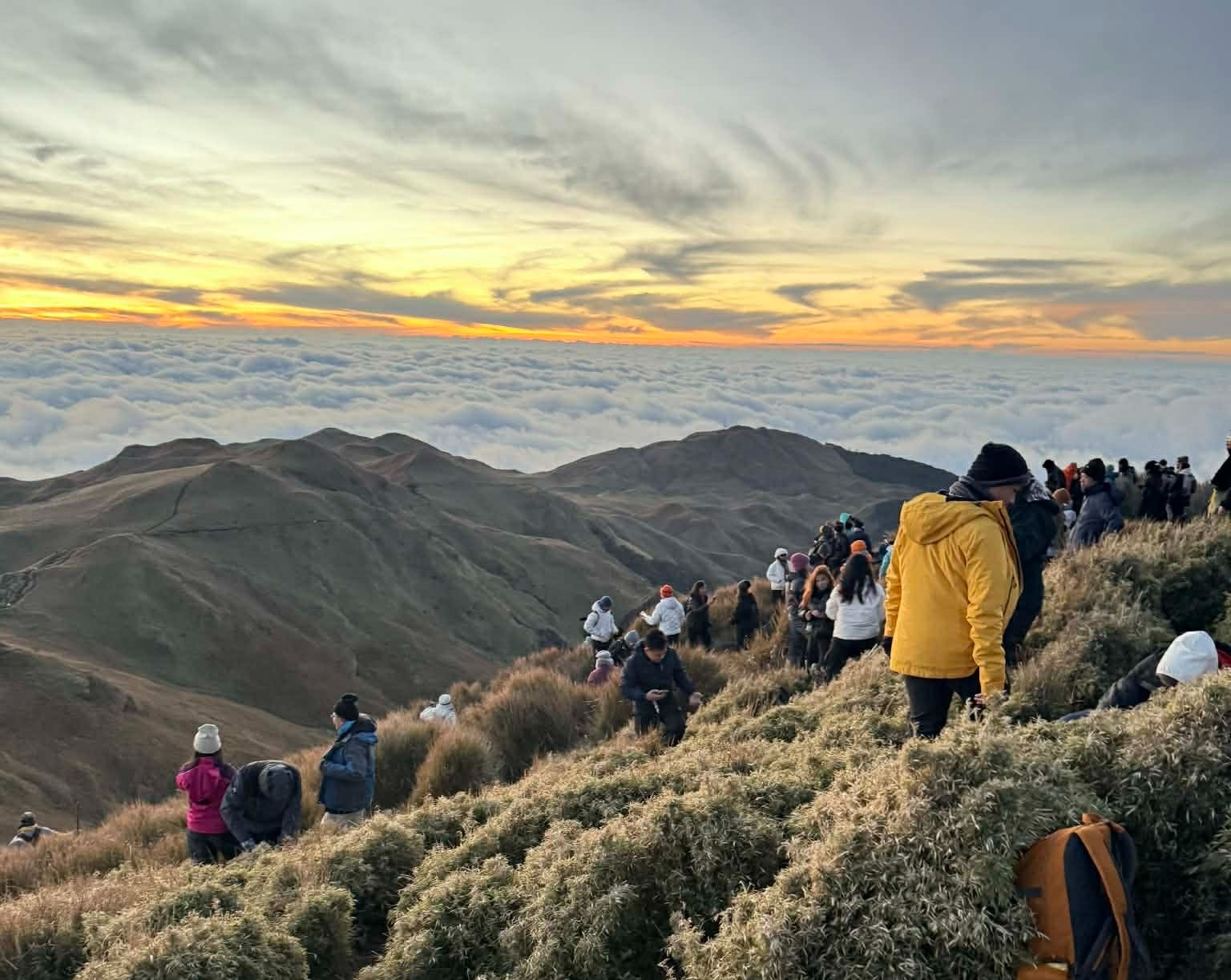
Situated along the borders of Benguet, Ifugao, and Nueva Vizcaya, Mount Pulag is the highest peak in Luzon at 2,928 meters above sea level and the third-highest mountain in the Philippines.
In 1987, Mount Pulag was proclaimed as a national park under Presidential Proclamation No. 75, mandating the government to protect the vegetation and wildlife of the mountain that are covered by a total of approximately 11,550 hectares.
The national park covers lowland forests from the ranger station and continues to mossy forest and dwarf bamboo grasslands, according to Arboleda.
“Majority of our wildlife when it comes to Mount Pulag [are] protected landscape and even in other primary forest mountains,” he said.
Currently, Mount Pulag has four trails that hikers can access:
However, the popularity of Mount Pulag among hikers caused concerns that are beyond foot traffic.
The national park’s carrying capacity of 600 people per day, based on the data of Mt. Pulag Protected Landscape Office, is more than half of the carrying capacity more than 10 years ago, which was capped at 120.
With the influx of hikers in Mount Pulag, Arboleda said environmental damage has become more evident, largerly driven by human activity.
“Siguro marami na rin pagbabago na hindi maganda between 2013 and the last decade or so. Ilang beses na ring napasara si Mount Pulag for unfortunate incidents,” he said.
(There are lots of negative changes between 2013 and the last decade or so. Mount Pulag has been temporarily closed numerous times because of unfortunate incidents).
In February 2025, the DENR announced the temporary closure of Mount Pulag’s Campsites 1 and 2 due to excessive trash.
A fire caused by a group of hikers also destroyed Mount Pulag’s five hectares of grassland in January 2018, prompting a six-month temporary closure of the Akiki Trail for rehabilitation.
While these accounts highlight problems brought by the number of people who climb Mount Pulag, they do not fully encapsulate the bigger picture.
For JP Alipio, founder of the Cordillera Mountain Ultra and director of Cordillera Conservation Trust, the more serious and long-term threat comes from agriculture.
“Agriculture has permanently destroyed hectares of Mount Pulag which is not repairable. You can't recover it,” said Alipio, “Farming has been the biggest destructive force [in] Mount Pulag… They are destroying a critical natural habitat,” he added.
According to the Philippine Journal of Science, agricultural lands in Mount Pulag increased by almost 8.96%, forest lands decreased by 8.35%, and built-up areas increased by 1.02%, prompting agricultural activities as the main causes of forest land loss.
Farming in Mt. Pulag is regulated through Republic Act No, 11685 or the Mount Pulag Protected Landscape Act, which declares that sustainable and small-scale agricultural activities are allowed only in multi-use zones and ancestral lands.
Failing to adhere to the regulations may result in farming activities being stopped, relocated, or redirected towards alternative livelihoods by the DENR and the Protected Area Management Board.
For the Cordilleran conservationist, while it is often portrayed that foot traffic is the primary environmental concern, he stated that only a small portion of the mountain is affected and accessed by hikers. Hiking activities are concentrated within the four trails, exposing only roughly 10% of the mountain’s land area.
While increased foot traffic remains a valid concern on environmental impact, Alipio maintains that tourism is a manageable issue that can be controlled and regulated.
The influx of hikers provides livelihood opportunities extending beyond Mount Pulag’s trails, from transportation services to guides, porters, and homestays for hikers.
“There are ways to manage the impact. Because if you look at the 1,000 people, that's a thousand people providing jobs to all of those people up on the mountain… The value chain is long,” Alipio said.
While tourism brings seasonal strain to Mount Pulag, agriculture causes sustained environmental damage in the long-term. Ultimately, both issues stress the need for tighter management and regulation.
“You can't blame the farmer also kasi wala silang trabaho (because they don’t have other sources of income). Which is why giving jobs to the people there is important, giving them alternatives to what is the more destructive practice,” Alipio said.
Addressing these challenges calls for inclusive solutions that explore ways to protect both Mount Pulag and the communities that depend on it.


